The $400m earworm: how Baby Shark created a global phenomenon

One catchy children’s song uploaded to YouTube helped spur a multinational business.
If you have kids aged under 10, chances are you’re likely not going to like the company we’re writing about today.
That’s because it is responsible for the insanely popular earworm Baby Shark.
A song that captured the attention of children around the world, and left parents desperately trying to get the “doo doo doo doo doo doo” chorus out of their heads as it played endlessly on repeat in the background.
The official video has amassed a mind-boggling 16.4 billion views on YouTube, making it by far the most popular video ever to appear on the platform.
It has also helped its creators Pinkfong build a multinational business worth $400 million (£306m) that has now been listed on the Korean stock exchange.
It’s fair to say the company has endured a volatile few days since listing, having seen shares soar 60% on the first day, then plummet to below its list price at the time of writing.
But let’s not let that distract from what is a truly remarkable success story.
Here, we'll take a closer look at how a simple, catchy tune accompanied by rudimentary animation became a global phenomenon that transformed the fortunes of a small Korean firm.
Finding a niche
While Baby Shark may have enjoyed a meteoric rise, it had been preceded by many years of hard work on the part of its creators.
Back in 2010, Kim Min-seok, Lee Ryan Seung-kyu and Park Hyun-woo set up a small company called SmartStudy.
It aimed to create digital content that would appeal to younger children.
Having initially cast a wider net in terms of potential audience, the trio settled over time on content for toddlers.
By 2016, the company had grown gradually and was now focused on creating simple, repetitive tunes and videos for the under-5 market.
An unexpected phenomenon
When the still largely unknown firm released Baby Shark that year, expectations were not especially high.
In a recent interview with the BBC, CEO Kim Min-seok explained how they “didn’t expect it to stand out from our other content".
How wrong they were.
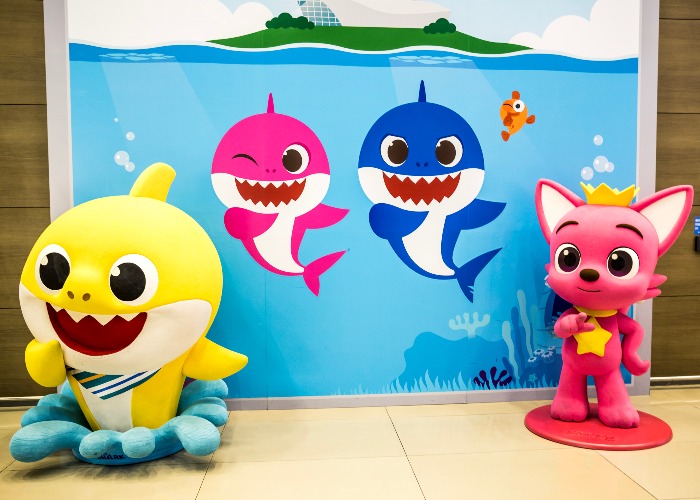
If you’ve somehow never seen it before, the video features an animated pink fox (named Pinkfong), sharks swimming, and two young children showing suggested dance actions to follow along to, all while an upbeat K-Pop-esque tune blasts away.
And, of course, a whole lot of “doo doo doo doo doo doos”.
The combination was clearly irresistible not just to toddlers, but to older children and even some adults as well.
After an initially quiet launch, it became a viral phenomenon that spread first across Southeast Asia and then the world.
The YouTube views began to rapidly mount up, passing one billion in late 2017.
If you consider that 1,000 views is generally worth somewhere between $2 (£1.50) and $5 (£3.80) to creators, they had likely earned millions of dollars in the space of 16 months off a single video.
And this was no short-term viral hit: by 2020, it became the most viewed YouTube video of all time, passed 10 billion views in 2022 and is now well over the 16 billion mark.
According to reports, that single catchy tune generated roughly half of the company’s income in the first years after its release.
Unsurprisingly, the revenue it generated offered critical support to the business as it sought to capitalise on its success and branch out into new areas.
No longer a one-trick pony
If you do a quick search online, you’ll see the company has dramatically increased its output of Baby Shark-themed content over the years.
It’s also expanded beyond Baby Shark, launching numerous movies, TV shows and musicals.
Perhaps the most successful venture to date has been the Bebefinn show, which launched in 2022 and can be watched on Netflix or Amazon Prime.
CEO Kim Min-seok told the BBC that Bebefinn content now outperforms that of Baby Shark, generating 40% of the company’s earnings compared to 25% for the latter.
The company is evidently well on the way to diversifying beyond the simple shark and fox characters that helped catapult it to global notoriety.
Indeed, it’s been reported that it now has more than 280 million YouTube subscribers across its various YouTube channels and churns out content in 25 different languages.
In amongst all this growth, the company changed its name from SmartStudy to PinkFong in 2022.
The change was said to signify the company’s shift away from solely toddler content to entertaining a wider audience.
As the Pinkfong Company noted when announcing the change: “We would like to create a culture that the whole family can enjoy beyond the children's educational company, which was the company’s initial identity...”
An empire founded by a fish
Fast forward to today, and the Korean company has 340 staff spread across branches in Singapore, the United States, China, and Hong Kong.
By listing on the Korean stock market this week, it has reportedly raised $52 million (£40m).
CEO Kim Min-seok said the funds will be used to help further grow its content production and create even more characters.
As the company eyes even greater global success, it’s remarkable to think none of it would likely be possible but for a 95-second video about some sharks and a pink fox named Pinkfong.