How trustworthy are supermarket product reviews?

Our research shows supermarket product ratings are being bolstered by reviews from brand websites and shoppers gifted free samples.
Just how reliable are supermarket product reviews?
Our research at loveMONEY suggests major supermarket websites may be populated with potentially biased reviews.
Many product reviews for certain groceries on these supermarket websites are not just from verified shoppers at that particular supermarket.
In our searches of the Tesco, Sainsbury’s and Asda grocery websites, we found thousands of reviews for certain products sourced from brands’ own websites and from people who had received the products for free.
Hundreds of reviews have also been sourced from Influenster, a website that sends individuals free samples in exchange for a review.
A member of the loveMONEY team came across the issue by chance. "A couple of years ago, Nestlé shrunk its CoffeeMate product while also hiking the price," he said.
"I gave it a one-star review on Tesco and noticed loads of people had done the same as a result of the fact it had basically gone up in price 40-50% overnight.
"I’d forgotten all about it, but recently, while shopping for a different brand of coffee whitener, I noticed the CoffeeMate rating out of five was notably higher than before.
"So, I looked into all the reviews and I noticed there were about 100, mostly from people who’d been given free products to review.
"The vast majority were five-star and hugely positive.
"The negative reviews were now buried at the bottom*, and the star rating had been massively skewed."
*The one-star reviews are now no longer visible on the page at all
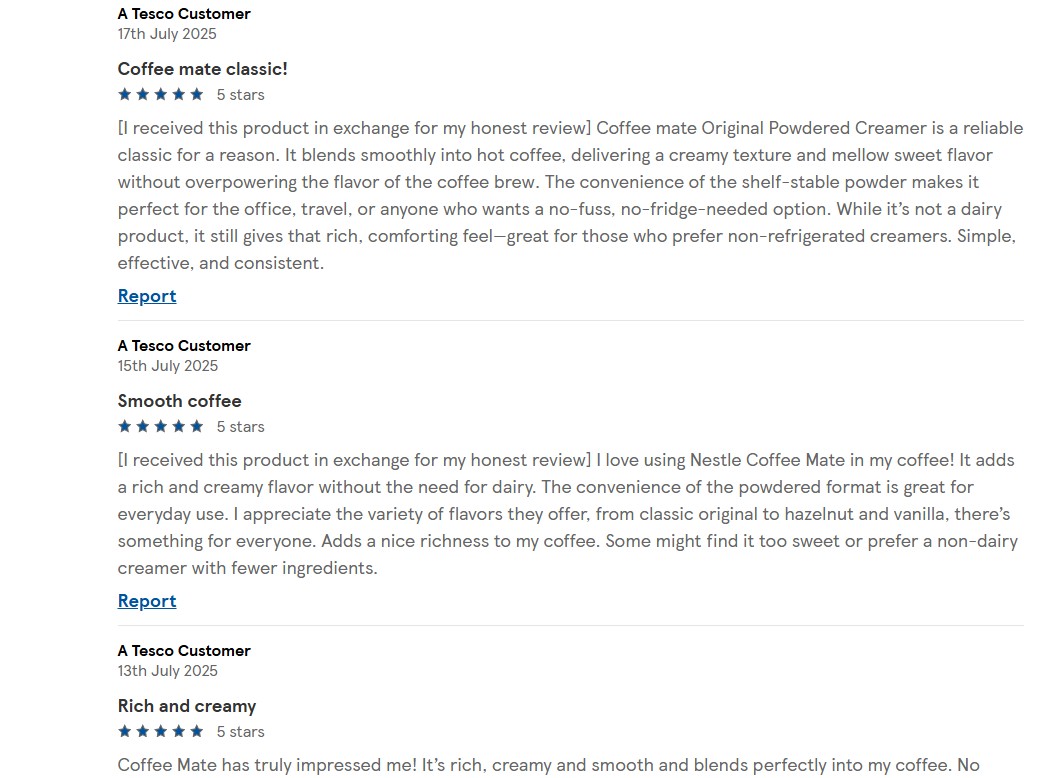
Some of the 5-star reviews of Coffeemate on the Tesco site
It's also worth noting that we found some reviews that are identical, but are flagged in different ways.
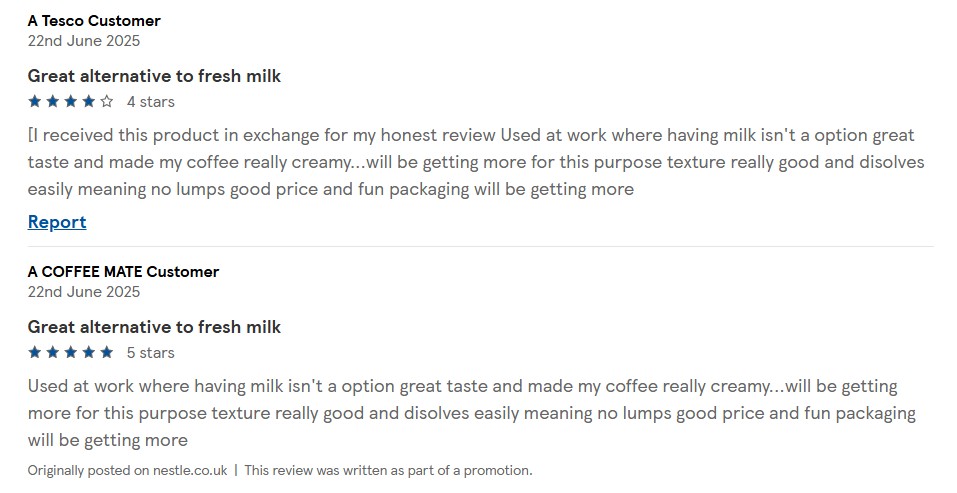
In the example below, you can see two reviews posted on the same day. The first is from "a Tesco Customer" and gives a four-star review, where they stipulate in the review that they "received the product in exchange for my honest review".
The second review, which gives the product five stars, comes from "a COFFEE MATE Customer" and it is flagged in small print below the review that it was "Originally posted on nestle.co.uk" and that "this review was written as part of a promotion".
The actual review itself is identical, including spelling mistakes (click to see a larger version).
 .
.
Hundreds more reviews of Nestlé, Unilever and Procter & Gamble products
Some major branded products, owned by large multinational companies, have an unusually high number of reviews on the Tesco, Asda and Sainsbury’s grocery websites.
Coffeemate, Kitkat (also owned by Nestlé) and many of the Nescafé coffee products all have hundreds, if not thousands more reviews on the Tesco, Sainsbury and Asda websites than other products from other companies – and many of these are sourced either from Nestlé.com and Influenster.
Nescafé Original Instant Coffee has 3,816 reviews on the Tesco website, and over 8,000 reviews on the Asda.com website, while Nescafé Cappuccino Instant Coffee 7 Sachets has 2,077 reviews and Nescafé Goldblend has over 5,000 reviews on Tesco.com.
Some Unilever and Procter & Gamble products also have an unusually high number of product reviews, with many of them resulting from free samples.
Ariel (Procter & Gamble) 3-in-1 Pod, for example, has 3,571 reviews on the Sainsburys.co.uk website, with many of them from reviewers who received the items free.
We checked for Dove and Persil on the Sainsbury's site (Unilever products) and, while there aren't as many as there were with certain Nestlé products, there are still 380 or so reviews, and again, many from people who were given free samples.
We compared reviews of products from other companies, such as Kenco, Walkers and McVities, and there are far fewer reviews - less than 100 rather than 1,500.
There is a real risk of misrepresentation to shoppers and other manufacturers if big supermarket websites list thousands of product reviews that may be skewed.
Many shoppers won’t necessarily take the time to dig into the text of the reviews, but only look at the star rating and the number of reviews on the product headline.
The supermarkets' response
We contacted all four major supermarkets - Tesco, Sainsbury's, Asda and Morrison's. Only Tesco responded to our enquiries.
The company did not provide a comment but directed us to their reviews policy online.
Tesco's reviews policy states that, to maintain transparency, the supermarket allows incentivised ratings and reviews only under the conditions that incentives must be clearly and prominently disclosed within the rating or review, incentives must not be contingent on a positive rating or review and that ratings or reviews that do not meet these requirements will be removed.
It also states that the company strives to present ratings and reviews fairly and accurately.
"Customers can expect: ratings and reviews to be displayed in an unbiased manner, no artificial weighting or suppression of negative ratings or reviews" and "the ability to report suspicious or inappropriate ratings or reviews.
"We proactively monitor our reviews and prevent the publication of any reviews that do not meet our ratings and reviews guidelines," it reads.
Sainsbury's did not respond. However, on its website, it says: "At Sainsbury's, we partner with leading software provider Bazaarvoice to collect, moderate, and display genuine customer reviews.
"The Bazaarvoice Trust Mark on our website shows our commitment to honest feedback.
"Bazaarvoice uses both automated tools and human moderators to verify that each review comes from real customers.
"Their technology detects fake or incentivised reviews, and we only remove reviews if they violate clear moderation guidelines.
"Our review process complies with the Digital Markets, Competition and Consumers Act 2024 regarding fake reviews."
What the law says
Under the Digital Markets, Competition and Consumers Act 2024, it is against the law to submit or commission fake reviews or a consumer review that conceals the fact that it has been incentivised.
The reviews mentioned above are all highlighted on the supermarket websites as being reviews from promotions.
However, "publishing consumer reviews or consumer review information in a misleading way" is also prohibited under the legislation.
As lawyers at Lewis Silkin note on the company's website: "This is likely to be interpreted broadly and, for example, will cover where negative reviews are removed or not published and where greater prominence is given to positive reviews.
"Even if you do not yourself submit, commission or publish fake or misleading consumer reviews, if a company or individual does this on your behalf, then you will still be caught by the new provisions."
We contacted Which?, part of the Consumer Association, and while they would not comment on the issue directly, they did warn consumers to ensure they read a variety of reviews with different star ratings before making a purchasing decision.