Follow this topicFollow this topic Knowledge » Gas and electricity

Why energy bills have trebled in eight years

Cliff D'Arcy
by Lovemoney Staff Cliff D'Arcy on 25 April 2012  |  Comments 29 comments

Cliff D'Arcy investigates why your energy bill has risen so much faster than the wholesale costs of gas and electricity.

Why energy bills have trebled in eight years

After switching off my home heating during March's heat wave, I then had to switch it straight back on again, thanks to a cold snap during and after Easter.

These days, my gas and electricity bills total around £1,500 a year, which works out at around £125 a month. This is a huge increase since 2004, when I remember paying around £50 a month to heat and power my (then smaller) home.

Why have the UK's domestic energy bills gone up so much in recent years? Is it profiteering by the energy companies, or it is simply the rising wholesale cost of producing power? The answer, it seems, is a bit of both.

1. Oil gushes upwards

Although the oil price has been rising for many years, it has done so in fits and starts, notably with a huge rise and fall during 2007 and 2008.

Ten years ago, a barrel of Brent Crude traded at around $25. By July 2006, it had tripled to $75, before falling back to $55 at the start of 2007. The oil price then exploded, soaring to a high of $147 in July 2008, before crashing back to $40 at the end of 2008. Since then, the price of oil has tripled, with a barrel of Brent now priced at almost $120.

In short, the oil price has more than quadrupled in the past decade and, inevitably, this extra cost has ended up being paid by consumers and businesses.

2. Gas goes bang

What's more, the wholesale price of gas has risen strongly in recent years. In fact, the wholesale price of gas has risen by three-quarters (75%) over the past seven years.

However, according to our energy partner energyhelpline, domestic gas prices have risen much more steeply. For example, the price per kilowatt-hour (kWh) of the British Gas Standard Quarterly Billing tariff has more than doubled, having risen 108% in the past seven years.

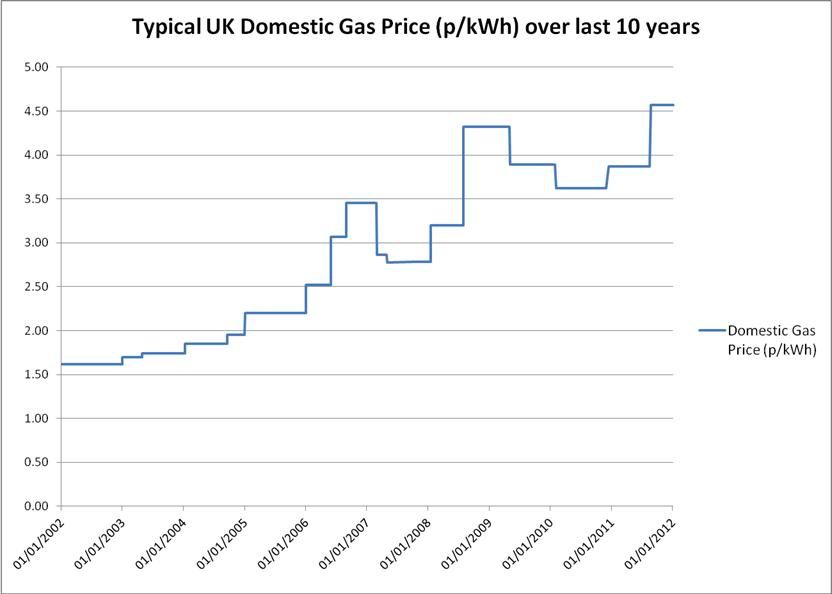
What's more, take a look at this graph, which shows how the typical cost of domestic gas has exploded since 2002:
Energy graph

Source: energyhelpline 

As you can see, despite drops in 2007 and 2009/10, the domestic price of gas has been rising steadily for most of the past decade. Indeed, the price today is close to its all-time high, with gas costing nearly three times as much as it did in 2002.

In short, domestic gas prices have risen much faster than wholesale prices, which suggests that British households are being ripped off when heating and eating.

3. An electric shock

In the past three years, the wholesale cost of electricity is up a modest 5%. Furthermore, it has tumbled about a fifth (20%) since peaking in November 2008.

Yet electricity prices have risen strongly over the past few years, as you can see from the following table. Some of them have even changed their prices on three separate occasions in that time:

Electricity price changes since 2010, by supplier

Supplier

Effective

date

Change

Effective

date

Change

Effective

date

Change

Atlantic

14/09/11

11.0%

-

-

-

-

British (Scottish) Gas

12/01/12

-5.0%

18/08/11

16.0%

10/12/10

7.0%

E.ON

27/02/12

-6.0%

13/09/11

11.5%

04/02/11

9.0%

Ebico

14/09/11

12.2%

-

-

-

-

EDF Energy

10/11/11

4.5%

02/03/11

7.5%

-

-

first:utility

01/12/11

9.5%

01/04/11

27.9%

23/02/10

11.0%

Green Energy UK

01/11/11

6.3%

01/05/11

3.9%

-

-

LoCO2 Energy

01/10/11

5.0%

01/01/11

5.9%

01/11/10

3.0%

London Energy

10/11/11

4.5%

02/03/11

7.5%

-

-

npower

01/10/11

7.2%

04/01/11

4.9%

-

-

Ovo Energy

10/01/11

7.5%

28/04/10

5.2%

25/03/10

-5.4%

Scottish Hydro

14/09/11

11.0%

-

-

-

-

Scottish Power

01/08/11

10.0%

25/11/10

8.9%

-

-

Seeboard

10/11/11

4.5%

02/03/11

7.5%

-

-

Southern Electric

14/09/11

11.0%

-

-

-

-

SWALEC

14/09/11

11.0%

-

-

-

-

SWEB

10/11/11

4.5%

02/03/11

7.5%

-

-

Utilita

01/09/11

0.8%

-

-

-

-

Utility Warehouse

16/09/11

9.4%

01/04/11

0.7%

-

-

Source: energyhelpline 

After several rounds of price rises in 2010 and 2011, a few electricity providers cut their prices earlier this year -- notably 'Big Six' suppliers British Gas (down 5% in January) and E.ON (down 6% in February).

Even so, the general trend has been strongly upwards, with some suppliers raising electricity prices by between 25% and 28% in a single round of rises.

4. No ratchet effect?

A ratchet is a gear that can rotate in one direction, but not the reverse. Thus, a ratchet can turn only one way. When looking at the domestic energy market, it may appear as if some sort of ratchet is at work, as prices always seem to be rising, but rarely fall back.

However, energy regulator Ofgem has investigated this market several times and found no evidence of any ratchet effect and/or collusion between suppliers. This table details the last movements in gas prices:

Supplier

Effective

date

Gas

Atlantic

26/03/12

-3.8%

British (Scottish) Gas

18/8/11

18%

E.ON

13/09/11

18%

Ebico

26/03/12

-4.5%

EDF Energy

07/02/12

-5.0%

first:utility

01/12/11

9.5%

Good Energy

06/09/11

9.4%

London Energy

07/02/12

-5.0%

npower

01/02/12

-5.0%

Ovo Energy

10/01/11

6.3%

Scottish Hydro

26/03/12

-3.8%

Scottish Power

27/02/12

-5.0%

Seeboard

07/02/12

-5.0%

Southern Electric

26/03/12

-3.8%

Spark Energy

01/07/09

-10.7%

SWALEC

26/03/12

-3.8%

SWEB

07/02/12

-5.0%

Utilita

01/09/11

12.6%

Utility Warehouse

01/03/12

-3.9%

Source: energyhelpline 

While a few suppliers have raised their rates in 2011/12, most of the bigger players have opted to reduce their gas tariffs. These include EDF Energy, London Energy, npower, Scottish Power and Seeboard, all down 5.0% -- which looks like 'suspicious clustering' to me.

Large increases in the cost of crude oil and natural gas have had a big impact on Britain's domestic energy bills over the last ten years. Nevertheless, with domestic price rises far outstripping wholesale increases, it certainly looks like the power companies are fleecing us!

More on gas and electricity bills:

Compare tariffs with lovemoney.com

Energy companies to tell customers about best tariffs

How to get free cavity wall and loft insulation

EDF announces price promise and help for vulnerable

You’re subsidising your neighbour’s energy bills!

Enjoyed this? Show it some love

Twitter
General

Comments (29)

  • majortruth
    Love rating 159
    majortruth said

    There seem to be four key issues that are not well covered by the article:

    1) Unless one has oil-fired central heating, oil prices have a negligible impact on energy bills with less than a quarter of one percent of electricity generated from oil (most of that is from light oil-fired Open Cycle Gas Turbines covering for drops in intermittent wind turbine output).

    2) The so called green obligation allows power producers to pay for wind and solar follies at inflated rates and then pass this huge cost of subsidising them directly on to the electricity consumer.

    3) Gas prices fluctuate and we are vulnerable to world price changes. However, our stalwart coal-fired power (currently cheaper than gas) plant has been meeting around 40% of the demand for electricity allowing us to cut back on more expensive gas-fired generation. When the EU forces us to shut down our coal plant because of emissions of CO2 (plant food), we will be much more vulnerable to world gas price fluctuations.

    4) Looking to the future, shale gas could be our salvation providing cheap and reliable energy for decades to come and eliminating high-cost imported gas.

    Why are these issues not made more open and people better informed where their money is going? No one who cares about their electricity prices would ever support building more hugely expensive intermittent wind follies.

    Report on 27 April 2012  |  Love thisLove  10 loves
  • Mike10613
    Love rating 599
    Mike10613 said

    I thought the government printing money caused commodities to go up in price. But, what do I know, with my loft insulation, cavity wall insulation, sealed windows, draught proofing and lower energy bills?

    Report on 27 April 2012  |  Love thisLove  1 love
  • Dampflok
    Love rating 22
    Dampflok said

    £125 per month? Lucky you. Our bill is £248 per month and that is low as we owe a couple of hundred. And that is the cost of heating only a few rooms, not the whole house, and at appropriate times of day. That's from hydro power for lighting and cooking and Calor gas for heating. No mains gas round here.

    Report on 27 April 2012  |  Love thisLove  1 love
  • tommills
    Love rating 23
    tommills said

    No mention of Green Taxes.

    Report on 27 April 2012  |  Love thisLove  8 loves
  • SevenPillars
    Love rating 70
    SevenPillars said

    Printing money also makes a difference. It should be remembered that all of our energy needs are speculative markets. Money chases those markets that are going up and since the Government and Central Bank intervention from 2008, energy markets have largely been on a bull run, when in 2007 deleaveraging and falling prices was at work. It's important to understand the way this system works. A money printing system needs inflation and hates deflation. Inevitably, those things that are needed the most will see the biggest price rises.

    Report on 28 April 2012  |  Love thisLove  0 loves
  • meldrewreborn
    Love rating 44
    meldrewreborn said

    Rather than relying on my imperfect memory I consulted mt financial records. My bills in 2004 were £621 and in 2011 they were £1150. I haven't moved. Its indisputable that prices have gone up but the amount is arguable. I also noticed that I was paying £27 per month to BT - and that bill has come down.

    But the measure of whether we're being ripped off is whether the profits of the utility companies as compared to the capital invested in their business is excessive.

    We live in a realatively wealthy country, and many of the fuel sources are priced according to world market prices. The markets work pretty well but are subject to abberations - gas prices in the US have collapsed because of plentiful shale gas that currently cannot be exported because they have no export terminals -only idle import terminals.

    The best way to proceed is to recognise that fuel prices are high, likely to go higher, and to insulate your property to the max. That's why my bills are comparitively low. But if you have no mains gas, air and ground source heat pumps are surely the way forward, perhaps together with solar thermal for hot water.

    Report on 28 April 2012  |  Love thisLove  0 loves
  • majortruth
    Love rating 159
    majortruth said

    The best way forward is surely for more coal, gas and nuclear power plant. Ignoring the costs of all these huge subsidies for "renewable" intermittent wind and solar pv is the way to higher prices. Note off shore wind is four times on shore and on-shore is not cheap. Exploiting our own (estimated 70 years reserves) of UK shale gas and continuing with coal fired power plant is the way to lower prices as I explained earlier.

    Remember the last government's Climate Change Act lets the UK people in for a declared £732 billion in additional costs to fail to solve a non-problem. We need to stop kidding ourselves on climate mythology and repeal the Act asap!

    The costs are stated in the Impact Assessment of the act as £18 billion per annum for 40 years = £732 billion total. They are actual costs and verifiable. The supposed savings quoted are pure conjecture based on 'King Canute' measures and pixie dust reducing extreme weather. IF there was any climate impact to be made form CO2 reductions, the UK's 1.9% even halved would be miniscule and undetectable on the world emmissions increases from China, India and Russia. See below:

    1 China emits 6,533 (21.6% of world emissions)

    2 USA emits 5,832 (19.2% of world emissions)

    3 Russia emits 1,729 (5.7% of world emissions)

    4 India emits 1,495 (4.9% of world emissions)

    5 Japan emits 1,214 (4% of world emissions)

    6 Germany emits 828 (2.7% of world emissions)

    7 Canada 573 (1.9% of world emissions)

    8 UK emits 571 (1.9% of world emissions)

    9 South Korea emits 542 (1.8% of world emissions)

    10 Iran emits 511 (1.7% of world emissions)

    -------------------------------------------------------------------

    World Emissions are 30,134 million tonnes pa (UP (9% on the 2005 figure and 1.7% on last year)

    source: EIA International Data

    Report on 28 April 2012  |  Love thisLove  7 loves
  • paintitblack
    Love rating 0
    paintitblack said

    Didn't take long for the climate change deniers to start spouting off did it? Pretending that climate change is a "non-problem" is so medieval c.f. flat earth isn't it?

    Funny how they always talk about the costs of climate change action, but never the benefits. The cost benefit summary of the Climate Change Act was published in 2009: the costs range from £324-404 Billion pounds over 40 years. Not £732 billion as majortruth(!!!) claims. The benefits range from £457-1020 billion. So the worst case scenario is a net gain of £53 billion. Best case scenario is £641 billion. http://www.decc.gov.uk/assets/decc/85_20090310164124_e_@@_climatechangeactia.pdf

    Report on 28 April 2012  |  Love thisLove  0 loves
  • paintitblack
    Love rating 0
    paintitblack said

    It is disingenuous to try to de-link coal and oil prices because so little oil is used for powering UK power stations: all the energy sources compete on the world market, so are interlinked. If oil goes up, then coal and gas can charge more.

    It is a shame that the article didn't show the effect of renewables on electricity prices: the "merit order effect" means that they reduce wholesale electricity prices. Google it.

    Report on 28 April 2012  |  Love thisLove  0 loves
  • majortruth
    Love rating 159
    majortruth said

    Lies from Green activists are quite commonplace unfortunately. One may ask who is a climate change denier? Climate has been changing for several billion years and is unlikely to stop. First we will consider the facts from the Met Office CRU data sets and the RSS data set.

    I challenge the doomsayer, paintitblack (as he/she obviously does) to find any global warming since 1997. Please tell us all how much in deg Celsius from the simple calculation: 14.34 - 14.34 = __

    Global Warming?....What Global Warming?

    Met Office releases new HadCRUt3 figures which show no warming over the past 15 years despite the largest increase in atmospheric CO2 concentrations since the Industrial era began.

    The CO2 Increase of more than 28 ppmv since 1997 has resulted in NO mean global temperature increase. The planet is at the same 14.34 degrees Celsius now as it was 15 years ago.

    RSS data confirms no warming and in fact shows a slight cooling since 1997.

    http://www.woodfortrees.org/plot/rss/from:1997/plot/rss/from:1997/trend

    Background

    The Earth has been warming up since the last Ice Age and has reached circa 14.0 to 14.5 deg C today. However, it should be noted that the temperature of the Earth has been as low as 10 degrees C and as high as 25+ deg C putting the past 15 years temperatures closer to the lower end of the geological reconstructions than the higher end. Scotese shows the maxima and minima as well as long term cycles of warm through to cold and so on.

    Ref Scotese Paleoclimate:

    http://www.scotese.com/images/globaltemp.jpg

    See the HadCRUt3 graph at:

    http://i.dailymail.co.uk/i/pix/2012/01/28/article-2093264-1180A4F1000005DC-28_468x286.jpg

    Report on 28 April 2012  |  Love thisLove  9 loves
  • majortruth
    Love rating 159
    majortruth said

    When renewable subsidies are being cut all over the world, how can the Greens claim ANY financial gain? Wind is uncontrollable and intermittent; in the UK, it is there, and paid for, when not needed and rarely there to meet peaks so saving nothing and costing £millions.

    Our NGC website may help people to see the futility of wind turbines:

    See which fuel types have been meeting UK electricity demand over 2011:-

    Uncheck all boxes then put each fuel type back in on its own and see how much of the demand has been met by each fuel type.

    Pop in wind on its own last for a good laugh. The blue graph that is there all the time is the demand profile.

    http://www.geog.ox.ac.uk/~dcurtis/NETA.html

    Report on 28 April 2012  |  Love thisLove  6 loves
  • majortruth
    Love rating 159
    majortruth said

    Wind Capacity Factor is Low (negligible) when needed to meet peak demand and so can never lead to building any less fossil fuel / nuclear plant.

    Wind power output is significantly variable and difficult to predict over several timescales, minutes, hours, days, weeks, months, and years.

    Variability over short time scales has been much discussed, and it is now well known that low wind conditions can prevail at times of peak load over very large areas. For example, at 17.30 on the 7th of December 2010, when the 4th highest United Kingdom load of 60,050 MW was recorded, the UK wind fleet of approximately 5,200 MW was producing about 300 MW (i.e. it had a Load Factor of 5.8%). One of the largest wind farms in the United Kingdom, the 322 MW Whitelee Wind Farm was producing approximately 5 MW (i.e. Load Factor 1.6%).

    Load factor in other European countries at exactly this time was also low. The Irish wind fleet was recording a load factor of approximately 18% (261 MW/1,425 MW), Germany 3% (830MW/25,777 MW), and Denmark 4% (142 MW / 3,500 MW).

    Such figures confirm theoretical arguments that regardless of the size of the wind fleet the United Kingdom will never be able to reduce its conventional generation fleet below peak load plus a margin of approximately 10%.

    They also suggest that while widespread interconnection via the widely discussed European Supergrid, may assist in managing variability, its contribution will not on its own be sufficient to solve the problems, since wind output is approximately synchronised across very large geographical areas.

    Conventional generators acting in the support role and guaranteeing that load is met will be faced with operating in a market that is physically and economically volatile.

    The now emerging fact that wind power can be highly variable year on year adds further layers of complication to this problem. Conventional generators will not only have uncertain income over shorter timescales, but will face significant year on year variations.

    The all but inevitable result of such uncertainties is higher prices to the consumer.

    Dr John Constable

    Dr Lee Moroney

    02.02.11

    http://www.ref.org.uk/publications/217-low-wind-power-output-2010

    Report on 28 April 2012  |  Love thisLove  7 loves
  • MK22
    Love rating 142
    MK22 said

    Majortruth, you are so funny!!! True the Global average from 1997 to 2012 has hardly changed. However, take 2000 to 2012 and we see a 0.3C increase in all global averages and if you take 1996 to 2012 the rise is nearly 0.5C increase. And if we take from 1950, a particularly cold year we see an inexorable rise of something approaching 0.75C over the last 62 years. Sorry, Majortruth, your point was?

    Report on 28 April 2012  |  Love thisLove  0 loves
  • majortruth
    Love rating 159
    majortruth said

    Your post is rather odd and cherry picked Mk22 (clearly if you pick a low start point, you can produce a "larger" result - not rocket science) but your post still goes to show just how minor (and well precedented in the geological timeframe) these natural variations in global temperature really are, a point I perhaps missed out when explaining.

    If you want a fuller picture of global temperature changes in terms of TRENDS (not odd cherry-picked years with deviant excursions) amounting to a very modest total of just 0.7 deg C up in the past 150 years (according to the IPCC report) then here it is:

    This shows that the effect of increased CO2 on global temperature is minor and natural cyclical causes are the primary drivers for climate.

    Information – Revised March 2012

    Analysis of Temperature Trends and CO2 rates of increase over 150 years – the ~60 year cycles

    Data from 1860 to 2010

    (Sources: Temperature Data: GISS; RSS; HadCRUT and CO2 data: Scripps)

    1860 to 1880 experienced 20 years WARMING with atmospheric CO2 increasing at the rate of 0.22 ppmv pa

    1880 to 1910 experienced 30 years COOLING with atmospheric CO2 increasing at the rate of 0.30 ppmv pa

    1910 to 1940 experienced 30 years WARMING with atmospheric CO2 increasing at the rate of 0.36 ppmv pa

    1940 to 1970 experienced 30 years COOLING with atmospheric CO2 increasing at the rate of 0.51 ppmv pa

    1970 to 2000 experienced 30 years WARMING with atmospheric CO2 increasing at the rate of 1.46 ppmv pa

    1997 to 2011 experienced 15 years flat-lining (cooling since 2002) with atmospheric CO2 increasing at the rate of 2.06 ppmv pa (more than at any other time post 19th century).

    It is also important to note that the Met Office (Climate Research Unit) recently released figures showing that the mean global temperature averaged over 1997 was 14.34 degrees Celsius, identical to the mean global temperature averaged over 2011. However, atmospheric concentrations of CO2 increased at the highest rate in 150 years over this same period, adding 8% to the 363 ppmv in 1997.

    This analysis shows that the effect of increased CO2 on global temperature is minor and ~ 60 year natural cycles are in evidence as the primary connection for climate change.

    Another point of interest that can be readily checked from the official data sets is that the global warming rate of increase from 1860 to 1880 was virtually the same as the rate of increase from 1975 to 1995 (around 0.16 degrees C per decade). This is despite the fact that CO2 was only increasing at 0.22 ppmv pa over the 1860 to 1880 period BUT at 1.48 ppmv pa over the 1975 to 1995 period.

    The barbed wire that the weak cagw hypothesis is caught on is that the empirical evidence does not support it. Note I say cagw not agw. AGW is a scientific fact but very minor (and certainly not catastrophic) unless huge leaps of faith on positive feedback through water vapour are assumed. Science is about falsifiable repeatable results - not assumption.

    Report on 29 April 2012  |  Love thisLove  8 loves
  • majortruth
    Love rating 159
    majortruth said

    Back on topic as climate digresses a little and nothing we do here would have any detectable influence on world CO2 emissions, let alone global climate - I can post Chinese emissions vs those of the UK if anyone is interested.

    Wind causing Price Rises for the Grid

    Prepare for more big, windfarm-driven 'leccy price rises

    Think it's bad now? Just wait, says Grid

    Analysis The National Grid has released a report into the way things are headed for the UK's electricity supplies in the coming decade, and it's not good news for anyone who finds their 'leccy bill to be a noticeable expense.

    No matter what happens to fossil fuel prices, British electricity is going to cost a lot, lot more in the near future as consumers pay for huge new windfarms to be built; pay their owners extra to turn them off more and more often; pay the operators of normal power plants more to provide backup for the windfarms and to cope with the damage caused by the windfarms to their equipment; pay yet more to get new interconnector cables to the Continent built; and pay again to support economically unviable storage technologies.

    The report assumes that by the year 2020 the UK's windfarm capacity will have increased by no less than seven times over today's level, which might - combined with increases in gas and nuclear, plus new interconnectors allowing more Continental imports - be enough to compensate for an anticipated halving of coal and the disappearance of oil-fired power stations. (Though one should note that this assumes that the big new windmills will achieve average load factors of 30 per cent, which so far windfarms have failed and are failing to do: 25 per cent is more likely. At that point we will still be getting 80 per cent of our electricity from non-renewable means: we will still, in fact, be using mainly coal and gas. But the arrival of these limited amounts of wind power is going to mean major effects on the grid and the electricity market.

    The Grid analysts write:

    During periods of minimum demand, renewable generation output is likely to reflect prevailing weather conditions rather than price signals ... it will become increasingly necessary to restrict the output from wind generation onto the system to ensure sufficient thermal capacity is synchronised to meet the technical requirements of operating reserve. Under this scenario it is estimated that it may be necessary to curtail wind output on about 38 days per year by 2020 ...

    The cost of constraining wind will become increasingly significant.

    The trouble is that although the wind farms will in reality produce no more than 16-17 per cent of the national requirement, when the wind is blowing hard they will be able to put out brief bursts at five times this level. Such brief bursts account for much of their average output over time, so the windfarm owners need to be paid for all that output even if it doesn't get used. This payment is very large - much larger than the price of the 'leccy, because of the Renewables Obligation Certificates system which is already driving up the price of electricity every year……………………….

    http://www.theregister.co.uk/2011/06/14/national_grid_2020/

    Report on 29 April 2012  |  Love thisLove  6 loves
  • majortruth
    Love rating 159
    majortruth said

    The costs to electricity consumers of paying for wind not to generate as wind blows at the wrong times when not rquired. Wind canot be despatched:

    More subsidies for wind turbines to stand idle in the little wind we do get:

    http://www.telegraph.co.uk/earth/energy/windpower/8770937/Wind-farm-paid-1.2-million-to-produce-no-electricity.html

    Wind farm paid £1.2 million to produce NO electricity

    A wind farm has been paid £1.2 million not to produce electricity for eight-and-a-half hours.

    he amount is ten times greater than the wind farm's owners would have received had they actually generated any electricity.

    The disclosure exposes the bizarre workings of Britain's electricity supply, prompting calls last night for an official investigation into the payments system.

    The £1.2 million will go to a Norwegian company which owns 60 turbines in the Scottish Borders.

    The National Grid asked the company, Fred Olsen Renewables, to shut down its Crystal Rig II wind farm last Saturday for a little over eight hours amid fears the electricity network would become overloaded.

    £532 million paid in subsidies by UK consumers to foreign owned/ part owned companies.

    Report on 29 April 2012  |  Love thisLove  7 loves
  • Offa
    Love rating 40
    Offa said

    So most of us realise that the 'climate change' scenario is a massive band wagon jumped on by politicians as it allows then to jet off to conferences the other side of the world ( first class) and reel off the amazing amount of turbines they are building to help the economy of other countries. All the time omitting to add - at the expense of the ordinary people m,some of whom will die because they cannot afford to heat their homes. Still never mind, our mates are making a bomb out of this and I am sure they will give me a job when I get kicked out of office.

    As for climate cahnge , of course it's changing and will for ever until the planet dies, which it certainly will. Who reat ly hink builkding wind farms wiill make life etrnal? DIs anyoine that crazy? Probably , looking at the posters talking as if they actually know what will happen in the future to a planet that has been 'maturing' for 14bilion years.

    Report on 29 April 2012  |  Love thisLove  6 loves
  • albatross5
    Love rating 50
    albatross5 said

    Majortruth has made several very well informed posts here, only straying from topic when challenged. It is strange that MK22 finds factual posts "funny" in some way.

    What is a climate change denier, someone who denies that the Jurassic Period was, on average, hotter than today? Does anyone do that? It does not seem that majortruth does as he/she gives a link to a paleoclimate chart. The mean global temperature of Earth has been down at between 13.7 and 14.4 deg C for the past 150 years whilst it was around 25 deg C in the Jurassic. The coldest was 10 deg C from memory.

    On energy costs, claims that wind and solar save the electricity customer money are obviously wildly contrived as both are heavily subsidised. Whilst majortruth has concentrated on wind follies, the domestic Feed-in-Tariff for solar pv users with installation prior to April 1st 2012 (i.e.what such domestic users are paid for their input) is still 43p per kwh. This is scandelous when coal and gas prices are competing for grid merit at between 6 and 8p per kwh. You'll never guess where that 43p subsidy comes from?.....yes people, your pockets as electrcity consumers.

    The domestic FiT was cut by government to 21p per kwh after April 1st 2012 for newly installed systems; still outrageous!

    Report on 29 April 2012  |  Love thisLove  6 loves
  • camanderm
    Love rating 50
    camanderm said

    Amen to the shale gas, majortruth. I am surprised that more have not picked up on that. It has brought lower gas prices in the USA, filtering through to the electricity prices. We have many decades supply under our feet in the UK. It's gotta be a no-brainer to access it and use it asap.

    Report on 30 April 2012  |  Love thisLove  6 loves
  • jegwe
    Love rating 20
    jegwe said

    Let us not forget that we are paying 5% extra in tax due to the insistence of the environmental lobby that energy was "too cheap". I have not noticed any campaign to remove this charge now that energy is becoming too expensive for vulnerable people to heat their homes properly.

    Report on 30 April 2012  |  Love thisLove  6 loves
  • sodit
    Love rating 127
    sodit said

    jegwe,

    that is because people don't matter, especially poor ones... not when you've got a planet to save.

    Report on 30 April 2012  |  Love thisLove  6 loves
  • nrgexpert
    Love rating 0
    nrgexpert said

    Great discussion and some interesting stats being contributed in relation to this topic. Those interested in keeping up with the latest energy tends in power generation, natural & shale gas, electricity, shale oil, wind etc may be interested in NRG Expert's range of energy sector reports...see website: http://ow.ly/aBRtZ

    Free White Paper downloads on Energy Efficiency, Smart Grid Security and Shale Gas Technology also available via above link.

    Report on 30 April 2012  |  Love thisLove  0 loves
  • marram
    Love rating 46
    marram said

    Enough shale gas to last 70 years? Very clever. Solve a problem by deferring it by one generation, leaving our children and grandchildren with the same headache. If runaway Global Warming were indeed a fact and not the product of fertile imaginations (or callous profiteering with 'green' taxes) then, surely, our energy needs particularly for heating, will go down. problem solved. and that is about as logical as the arguments for global warming. One way to help the poor (who always suffer most in times of economic stress) is to discount heating to those on benefits. I can't see that ever going down well with the powers that be.

    Report on 03 May 2012  |  Love thisLove  0 loves
  • yocoxy
    Love rating 132
    yocoxy said

    "70 years of shale gas" ...... And then....?

    There needs to be a gradual change from fuels that will enviably get more expensive until the point where they are no more, to alternatives that are expensive when the technology is immature but will eventually cross the graph of prices of existing fuels as one is rising and the other falling.

    ...or.... let's use it all now! Full steam ahead! Let my grandchildren worry about their problems when the time comes, I just want cheap fuel now!

    This is not about climate change, it's about having available resources long term. (beyond your quoted 70 years of gas or maybe a couple of hundred of oil)

    Report on 03 May 2012  |  Love thisLove  0 loves
  • Stargazer
    Love rating 11
    Stargazer said

    Climate change or not, there is still the question of whether using the planet's non-renewable resources is sustainable in the long term.

    Anyone looking for a no-holds-barred appraisal of where UK energy is coming from and where it might come from in the future should take a look at an excellent publication, 'Sustainable Energy Without the Hot Air', by Prof David Mackay. In it Prof Mackay looks at many options for sustainable energy generation, from wind farms to solar panels in the Sahara, and takes a detailed look at what a typical household can do to save energy, backed up by his own experiments at home. The book is available as a free download from http://www.withouthotair.com/

    Report on 03 May 2012  |  Love thisLove  0 loves
  • majortruth
    Love rating 159
    majortruth said

    We do not and should not need to shrink our lifestyles to the doomsayers agenda – the UK government should protect our lifestyles:

    UK Energy – The Logical Solutions

    In the UK we have sufficient coal reserves to produce electricity, syngas for more efficient power generation and transport and syncrude for transport. There is no shortage of nuclear fuels.

    Taken together, we have sufficient energy resources but lack the production assets to deal with the energy conversion processes to keep the price natural gas competitive.

    We need in the UK NOW to start on:

    - More Nuclear power plant

    - Investment in thorium reactor technology development

    - More Coal power plant

    - More Natural gas plant (whoopee for the abundance of shale gas)

    - More Syngas plant

    - Coal/syncrude conversion plant

    What we don't need is :

    - Any more Unreliable Intermittent Overpriced Windfarms;

    - hugely expensive tidal or wave power;

    - Grossly inflated solar subsidies;

    - Money wasting on "green spy smart" meters (scary big Orwellian stuff);

    - Pseudo Green CAGW Ideologies.

    For the long term future we can be sure of further shale gas and of course fisiionable materials. We really can do without green stargazers limiting and damaging our lifestyles.

    Report on 03 May 2012  |  Love thisLove  7 loves
  • majortruth
    Love rating 159
    majortruth said

    Development of a secure and reliable power plant mix for the UK in some more detail:

    One accusation erroneously levelled at me regarding my outline energy strategy for the UK is that it is ‘business as usual.’ It is not in any way BaU because it introduces a requirement for the following new features:

    1 Adequate funding for the development of thorium reactors;

    2 Additional new uranium nuclear plant;

    3 full exploitation of shale gas and 6 months storage facilities for natgas with more highly efficent CCGT plant;

    4 Coal to syncrude and syngas production plants (note: we have 300 years of coal in reserve in the UK);

    5 More new coal fired plant IGCC (with carbon capture only if this can be made profitable from product sales)

    6 New conventional coal-fired power generation plant without carbon sequestration (which is unnecessary, unproven and hugely expensive). Germany has 29 such new plants underway);

    7 All subsidies for wind and solar at all levels to be abolished forthwith;

    8 the electricity power grid to remain a secure source of energy supply with no costly and dictatorial “smart” cut-off features to ‘big brother’ our lives;

    9 just sufficient distillate-fired OCGTs to ‘keep the lights on’ in emergencies and keep plants happy wih lots of lovely CO2; also to cover for existing wind follies.

    This will both keep the lights on for our, our childrens' and grandchildrens' foreseeable futures and avoid our vulnerable suffering even more fuel poverty from the fatally flawed Green agenda.

    Report on 03 May 2012  |  Love thisLove  7 loves
  • cleogen_blue2
    Love rating 73
    cleogen_blue2 said

    I note marram and yocoxy seem to think that there is something very finite about initial estimates of 70 years shale gas. Let me remind all that 40 years ago there was only 40 years oil left and I see no sign of it abating, in fact, the link below suggests there are still more reserves than ever thought. It is highly unlikey that OPEC would want us to think that oil is not as scarce as they thought as it will lead to price reductions (as will shale gas of course).

    What is happening in fact (not stargazing fantasy) is that geological detection and recovery technologies for oil and gas are improving all the time. Coal is also held in huge reserves in the UK and only wating for the technology and oil/gas price regimes to exploit it.

    The largest fear for future generations is that we in the UK embrace 'cloud cuckoo land' wind and solar energy (miniscule contributions due to intermittency of "fuels") and fail to invest in real effective energy for them now from nuclear and fossil fuels. New generations must and will of course seek new cost-effective energy sources but they have plenty of time to do so. Have faith in our future people and technology development greenies.

    World is now gaining oil – OPEC Report

    http://www.opec.org/opec_web/static_files_project/media/downloads/publications/ASB2010_2011.pdf

    Please note that not much of our electricity in Britain is generated from oil as majortruth mentions but we need it for transport and manufacturing.

    Report on 03 May 2012  |  Love thisLove  7 loves
  • yocoxy
    Love rating 132
    yocoxy said

    When I was at school we were taught that oil production would peak around 2030 and then decline. That isn't far off current estimates. So I wonder who was predicting 40 years of oil 40 years ago?

    "no sign of it abating"? Now there's an open minded view! Hahaha

    Report on 09 May 2012  |  Love thisLove  0 loves

Post a comment

Sign in or register to post a reply.

Our top deals

Credit card
company
Balance transfers rate and period Representative
APR
Apply
now

Barclaycard 27Mth Platinum Visa

0% for 27 months (3.5% fee) Representative 18.9% APR (variable) Apply
Representative example: assumed borrowing of £1,200, representative 18.9% APR (variable). Purchase rate 18.9% PA (variable). BT fee is reduced from 3.9% to 3.5% (T&Cs apply).

Barclaycard 25Mth Platinum Visa

0% for 25 months (2.4% fee) Representative 18.9% APR (variable) Apply
Representative example: assumed borrowing of £1,200, representative 18.9% APR (variable). Purchase rate 18.9% PA (variable). BT fee is reduced from 3.5% to 2.4% (T&Cs apply)

Halifax BT 25 Month MasterCard

0% for 25 months (2.5% fee) Representative 18.9% APR (variable) Apply
Representative example: assumed borrowing of £1,200, representative 18.9% APR (variable). Purchase rate 19.0% PA (variable).
W3C  Thank you for using CGWEBLIV3